





Selittel® Fuse Application & Selection Guide
Overview

Selittel® (Dongguan Selittel Fuses MFG Co., Ltd. and its Hong Kong branch) is a professional manufacturer of fuses, also known as circuit protection fuses or fuse links, as well as fuse holders and related accessories. Its products are widely used in automobiles, household appliances, electric forklifts, construction machinery, special-purpose vehicles, marine applications, and more.
A fuse is an intentionally designed weak point in a circuit that is sensitive to current. Its main function is to melt reliably under overload or short-circuit conditions, thereby protecting downstream components and the entire circuit.
The following sections introduce the basic characteristics of fuses, their application areas, the features and selection of automotive fuses, the Selittel® product range, and relevant fuse standards.
Applications
Typical Fuse Applications
Fuses are widely used across industrial equipment, consumer electronics, and automotive systems.
In industrial equipment, motors, transformers, and control cabinets often require fuses with high breaking capacity to protect against overloads and short circuits.
In consumer electronics and home appliances, small cartridge fuses or surface-mount fuses are commonly used in TVs, computers, and household devices to prevent power faults from damaging sensitive components.
In automotive electrical systems, fuses are indispensable. When a short circuit or electrical fault occurs, a fuse disconnects the circuit by melting itself, preventing excessive current from overheating the wiring harness and even causing fire. In addition, lighting systems, in-vehicle audio, electronic control units (ECUs), and many auxiliary circuits all rely on fuses for overcurrent protection. Automotive blade fuses are typically installed in fuse boxes under the dashboard or inside the engine compartment.
Fuses are also widely used in power distribution systems such as distribution panels and transmission lines, energy storage systems such as solar battery packs, and telecommunications and data center equipment, serving as front-line protection devices that prevent widespread shutdowns caused by electrical faults.
Basic Characteristics & Concepts
Fuse Characteristics and Concepts
The rated current (nominal current) of a fuse is the continuous current value determined by the manufacturer under controlled test conditions. For safety, the actual operating current is usually recommended to stay below 75% of the rated value at 25C. This is called derating. For example, a 10A fuse is generally recommended for use below 7.5A at 25C. This is because a fuse is inherently temperature-sensitive, and its parameters are typically measured at 25C. Even a slight increase in ambient temperature can affect fuse life. Most traditional fuse materials have relatively low melting temperatures and are highly sensitive to changes in ambient temperature.
The rated voltage of a fuse indicates the highest system voltage that the fuse can safely interrupt after it opens. At the instant the fuse element melts, an arc is generated across the gap. If the system voltage is higher than the fuse's rated voltage, the arc may not be stretched and extinguished quickly enough and may even restrike, creating a sustained arc. This not only defeats the protective function, but may also lead to carbonization, flashover, or fire. Therefore, the rated voltage must be greater than or equal to the actual operating voltage of the circuit.
The breaking capacity of a fuse refers to the maximum current it can safely interrupt under short-circuit conditions and is usually defined by the applicable standard.
A fuse datasheet typically includes parameters such as rated current, rated voltage, breaking capacity, opening time, temperature rise curve, and time-current characteristics. In circuit design, these parameters and curves can be used for preliminary selection, but the final model should still be confirmed based on the actual load waveform and fuse test results.
For more details about fuse characteristics and concepts, please refer to Fuseology - Fuse Features.
Automotive Fuses
Definition and Types of Automotive Fuses
Automotive fuses are mainly used to protect vehicle electrical systems, and are also widely used in EVs, battery-powered vehicles, forklifts, special-purpose vehicles, marine systems, and energy storage battery packs.
Most automotive fuses are rated at 32V, while higher-voltage versions such as 58V or 80V are also available. These are commonly used in new energy electric vehicles, electric forklifts, and energy storage systems for low-voltage DC vehicle applications.
The most common automotive fuse types are blade fuses and bolt-down fuses.
These fuses use a plastic housing with two metal blades and plug directly into a fuse box or fuse holder. They are the most common type of automotive fuse.
Depending on size and current rating, blade fuses include Selittel® ATT (also called MICRO, rated 2A-30A at 32V/58V), Selittel® MIN (also called MINI, rated 1A-40A at 32V/58V), Selittel® ATO (also called ATC, rated 1A-40A at 32V/58V/80V), and Selittel® MAX (also called MAXI, rated 20A-120A at 32V/58V).
Each fuse housing is typically marked with its rated current and uses color coding for identification.
Bolt-Down Fuses (also called bolt-on fuses):
These fuses are larger and feature metal terminals with mounting holes at both ends. They are secured to fuse holders with bolts and are designed for high-current applications.
Depending on size and opening characteristics, bolt-down fuses include Selittel® ANS (also called MIDI, rated 20A-200A at 32V/58V/70V), Selittel® ANM (also called MEGA, rated 40A-600A at 32V/58V/80V), Selittel® ANL (rated 20A-600A at 32V/58V/80V), Selittel® CNL (also called ANL, a fast-acting fiberglass large bolt-down fuse rated 35A-800A at 80V/125V), and Selittel® CNN (also called ANN, an ultra-fast fiberglass large bolt-down fuse rated 10A-800A at 80V/125V).
Bolt-down fuses cover a wide current range from 10A to 800A, with typical voltage ratings from 32V to 125V.
They are commonly used in special-purpose vehicles, heavy machinery, marine equipment, and high-power automotive systems to protect critical circuits such as batteries, alternators, and starter motors.
Selection Guide
Fuse Selection Guide
To ensure reliable circuit operation, fuse selection should take multiple factors into account.
First, the rated current is usually chosen based on the circuit's normal operating current. In general, a fuse rated at about 1.35 to 1.5 times the normal operating current is recommended to avoid nuisance opening when ambient temperature rises.
The rated voltage must be greater than or equal to the operating voltage of the protected circuit. If a fuse is used above its rated voltage, it may still fail to extinguish the arc effectively even after opening, which can result in continuous arcing, sparks, overheating, insulation damage, or even fire. Therefore, voltage rating selection affects not only whether protection functions properly, but also the overall safety of the circuit.
Ambient temperature must also be considered because it affects fuse life. In high-temperature environments, the selected fuse rating should be increased accordingly, typically by about 10-15% for every 20C increase, to reduce the risk of premature opening or nuisance operation.
For circuits with motors or large capacitors, the fuse time-current characteristic and I2t value should also be considered. In such cases, time-delay or very slow-blow fuses may be needed to withstand startup inrush current.
At the same time, the maximum fault current of the system should be calculated to ensure that the selected fuse has a breaking rating no lower than that value.
Finally, confirm the size limitations of the fuse structure, the type of fuse holder, maintenance and installation requirements such as ease of replacement or visual indication, and whether the product carries the required approvals or certifications, such as UL, CSA, CE, VDE, or CCC. Please also refer to the standards section below.
Only by considering all of these factors together can you select a safe and reliable Selittel® fuse and achieve effective circuit protection.
For a more detailed fuse selection guide, please refer to Fuseology - Fuse Choosing Guide.
Related Standards
Fuse Standards and Certifications
Selittel® fuse products are designed, tested, and certified in accordance with multiple international and regional standards, covering industrial, power distribution, and automotive electronics applications to meet different market requirements for safety, reliability, and compliance.
Common fuse standards and certifications complied with or obtained by Selittel® include:
UL 248 General International Fuse Standard
UL 248 is a widely adopted low-voltage fuse safety standard in North America. It specifies rated voltage, rated current, breaking capacity, and opening characteristic test methods for different fuse applications. The standard focuses on whether a fuse can safely interrupt fault current and extinguish the arc under overload and short-circuit conditions without cracking, splashing, or igniting surrounding materials.
IEC 60269 General International Fuse Standard (China equivalent: GB/T 13539)
IEC 60269 is the International Electrotechnical Commission's low-voltage power fuse standard and is widely used in Europe and other regions. It defines fuse ratings, time-current characteristics, breaking capacity classes, and test conditions to ensure consistency in performance and safety across different manufacturers. It is applicable to industrial power systems and some vehicle electrical systems.
GB/T 13539 is the Chinese national standard corresponding to IEC 60269, with technical content that is essentially aligned with IEC 60269.
ISO 8820 Automotive Fuse Standard (China equivalent: GB/T 31465)
ISO 8820 is the international standard for low-voltage fuses used in automotive electrical systems. It defines the dimensions, electrical performance, and test methods for automotive fuse types such as blade fuses and bolt-down fuses. The standard emphasizes wiring harness protection and safe interruption performance in vehicle DC systems and applies to passenger and commercial vehicle electrical systems.
GB/T 31465 is the Chinese national standard corresponding to ISO 8820, and its technical content remains aligned with ISO 8820.
AEC-Q200 Automotive Passive Component Reliability Standard
AEC-Q200 is a general reliability specification for passive components in automotive electronics. It includes systematic testing for temperature cycling, high-temperature life, mechanical vibration, humidity, and other harsh operating conditions. Compliance with AEC-Q200 means that a fuse can maintain stable performance during long-term vehicle operation and in complex environments.
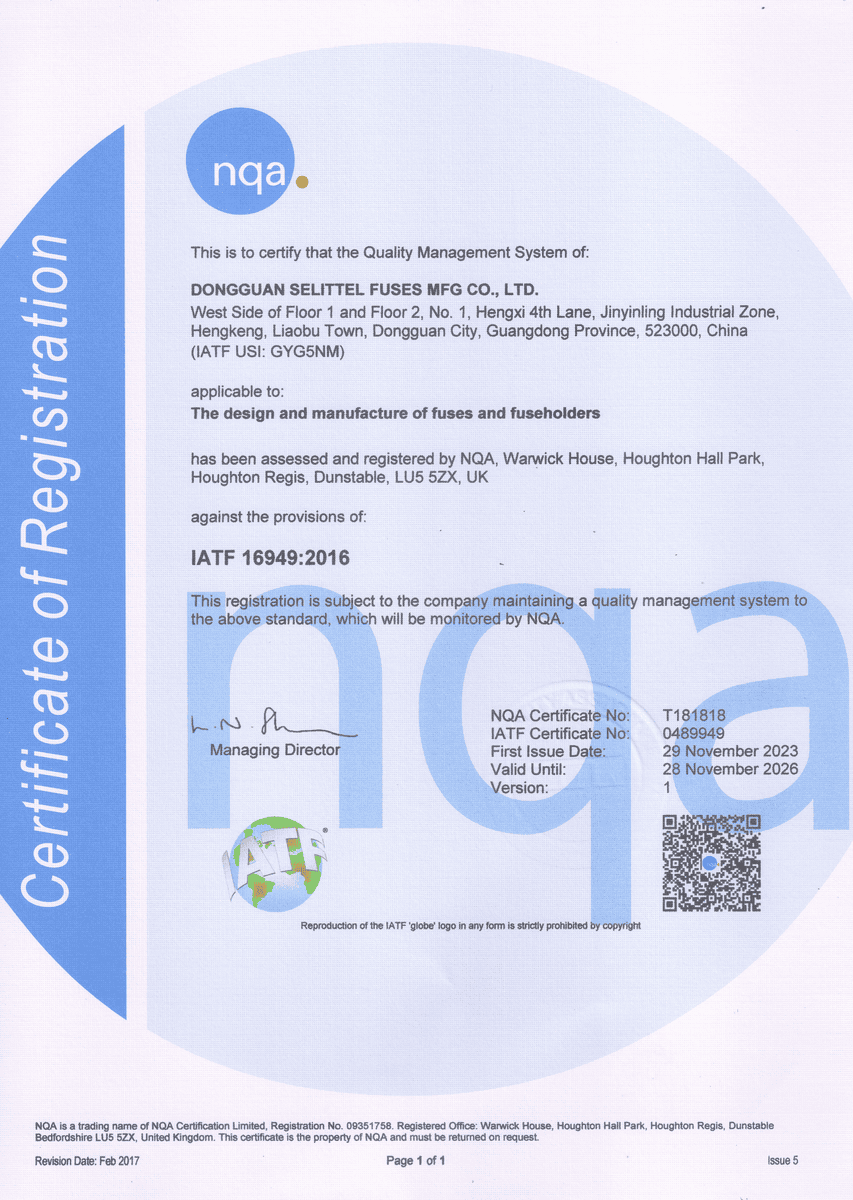
IATF 16949 Automotive Quality Management System (also known historically as ISO/TS 16949)
Selittel® manufacturing operations comply with and are certified to the IATF 16949 automotive quality management system. Based on ISO 9001, this system sets stricter requirements for the automotive industry and emphasizes full-process management from raw materials and process control to traceability and continuous improvement, ensuring batch consistency and long-term supply stability. It is a basic entry requirement for global OEM and Tier 1 supply chains.
ISO 9001 Quality Management System
ISO 9001 is one of the world's most widely adopted quality management standards. It provides organizations with a framework for consistent processes, continuous improvement, and customer focus to ensure that products and services meet customer and regulatory requirements while improving satisfaction and operational efficiency.
IATF 16949 fully covers the quality management requirements of ISO 9001. Therefore, when Selittel® is certified to IATF 16949, it also satisfies the general ISO 9001 quality management requirements applicable to both automotive and non-automotive products.
RoHS and REACH Environmental Compliance
All Selittel® products comply with environmental regulations such as RoHS and REACH, restricting the use of hazardous substances including lead, mercury, and cadmium, and helping meet EU and global market access requirements.
Other Regional and Safety Certifications
Selittel® products also comply with or have obtained certifications such as CCC/CQC (China), CE (European Union), VDE / TUV (Germany), CSA (Canada), EK (Korea), and ASTA (United Kingdom), ensuring safety and suitability under different regulatory systems.
For more information on fuse standards, please refer to Fuseology - Fuse Standards.
Selittel® Product Range
Selittel® Fuse Product Coverage
Selittel® offers a comprehensive product line in automotive and electronic circuit protection, including blade fuses, bolt-down fuses, cartridge fuses, surface-mount fuses, resistor-type fuses, cylindrical fuses, square backpack-style fuses, marine MRBF fuses, resettable circuit breakers, and more.
All automotive fuses and matching fuse holders have obtained CE certification, and some products have obtained UL certification.
Visit our online product catalog to start your selection.
